BOTANICAL INGREDIENTS · BUYER EDUCATION & RISK
Two cranberry extracts can both say “25% PACs” and still belong on different buying spreadsheets. Before you negotiate the price, find out what that percentage actually measures.
A quotation lists cranberry extract at 25% PACs. Your brief calls for a urinary-health capsule, and marketing has highlighted “36 mg PACs.” It looks like a simple calculation. But if the assay, reference standard or reporting basis differs from the evidence behind the brief, the arithmetic can be correct while the ingredient decision is wrong.
This guide works through the three decisions that matter: whether two grades are comparable, what the clinical literature actually supports, and how much a usable formulation costs.
01 “25% PACs” Is Not a Complete Specification
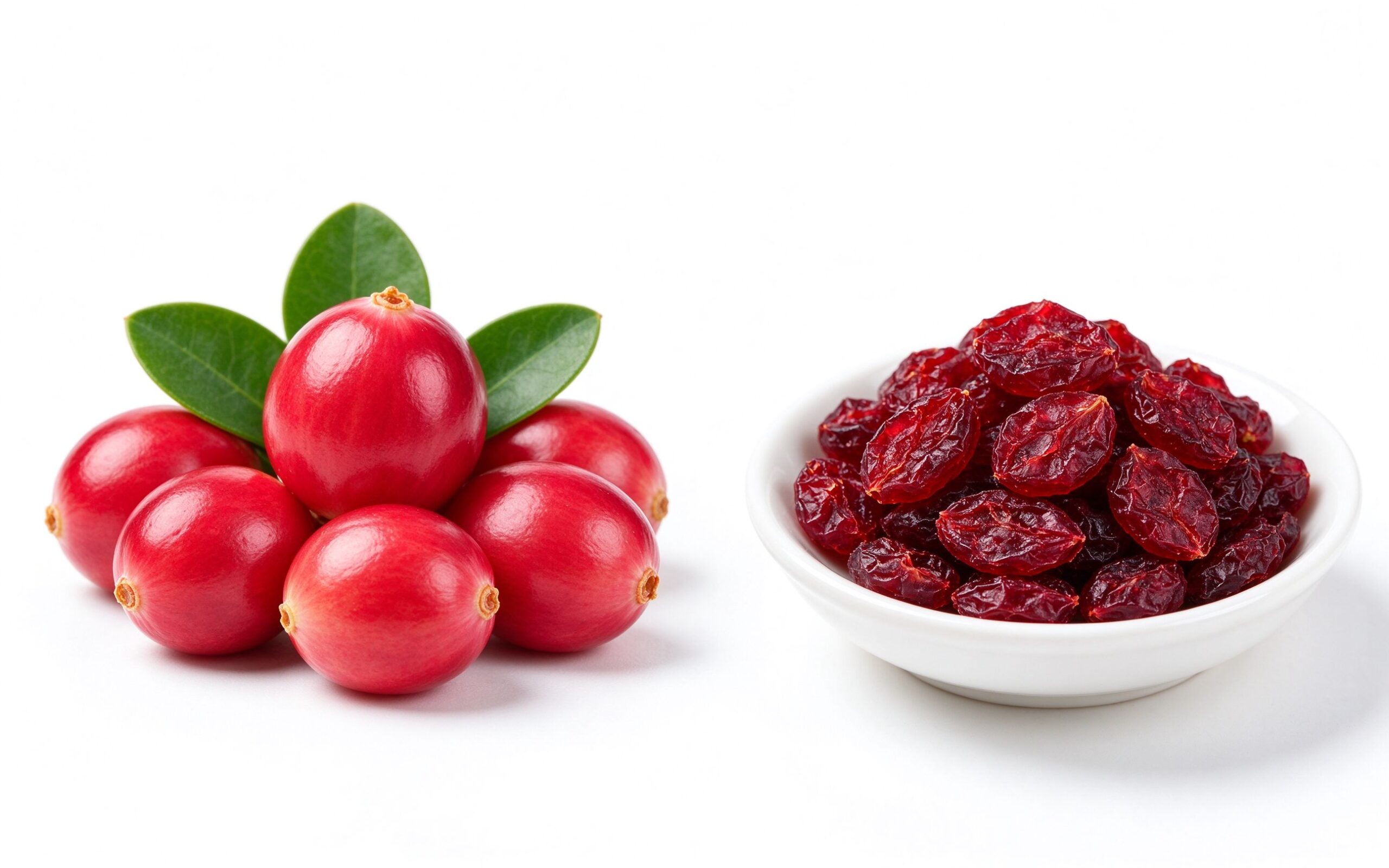
PACs are proanthocyanidins, a family of polyphenols rather than one interchangeable molecule. A useful specification identifies the cranberry source, the measured fraction, the analytical procedure and its calibration standard. “PACs by UV” leaves too much unanswered.
The important distinction is not simply UV versus DMAC. DMAC is itself a colorimetric assay read with a spectrophotometer. “UV” may describe equipment or a broad analytical approach; ask for the actual method rather than treating the label as proof of quality.
An inter-laboratory validation of AOAC First Action Method 2019.06 examined soluble cranberry PACs using DMAC and compared procyanidin A2 with a cranberry PAC reference standard. That calibration detail matters when interpreting the number on a certificate. [1]
| What the quotation says | What procurement still needs |
|---|---|
| 25% PACs | Which method, calibration standard and measured PAC fraction? |
| Tested by UV / HPLC | Method identifier, analyte definition and a relevant batch result. |
| Standardized cranberry extract | Botanical identity, fruit material, carrier composition and assay basis. |
| Equivalent to a researched dose | The named study and a defensible match to its preparation and assay. |
A total PAC assay alone does not establish botanical authenticity or quantify the share of A-type linkages. When identity is uncertain, ask the laboratory what additional characterization or fingerprinting supports it. A high PAC number cannot answer every quality question.
02 What Does the “36 mg” Research Really Mean?
The familiar number is a useful prompt to open the research, not a universal instruction for every cranberry powder. Three different kinds of evidence are often compressed into one sales claim:
- Anti-adhesion research: A 2010 study involving 32 volunteers measured bacterial anti-adhesion activity in collected urine. It reported dose-dependent activity, including activity extending to 24 hours with 72 mg PACs. Its endpoint was not a count of clinical infections prevented. [2]
- A dose-comparison trial: A 2021 randomized trial enrolled 145 women and compared 37 mg with 2 mg PACs daily for 24 weeks. The overall reduction in symptomatic infections was not statistically significant: incidence rate ratio 0.76, 95% CI 0.51–1.11. A favorable post-hoc subgroup result should not be presented as the overall trial result. [3]
- The wider evidence: The November 2023 Cochrane review included 50 studies and 8,857 participants. It supported benefit in some populations, including women with recurrent UTIs, but could not establish a clear difference between low, moderate and high PAC doses. [4]
What this changes for a brand: Build the ingredient brief around the intended population, preparation, assay and finished-product evidence. Do not borrow a study’s headline while changing all four. Prevention research also does not establish treatment of an active infection.
03 The Cheaper Kilogram Can Produce the Dearer Formula
Once two materials pass the same identity and quality requirements, compare cost at the required inclusion rate. A lower price per kilogram can disappear when the formulation needs more powder.
Illustrative calculation only: Assume a development brief specifies 36 mg of measured PACs per daily portion. This is a costing target, not a dosage recommendation. Assume both grades use the same validated assay, reference standard and as-supplied basis, with equivalent suitability for the application.
| Costing input | Grade A | Grade B |
|---|---|---|
| Assumed PAC content | 10% | 25% |
| Hypothetical price | US$70/kg | US$140/kg |
| Powder per daily portion | 360 mg | 144 mg |
| Powder per 1,000 daily portions | 0.360 kg | 0.144 kg |
| Ingredient cost per 1,000 portions | US$25.20 | US$20.16 |
In this example, Grade B costs twice as much per kilogram but 20% less at the target inclusion rate. It also leaves 216 mg more formulation space per daily portion. Neither conclusion proves clinical equivalence or guarantees a smaller capsule; density, excipients and manufacturing performance still matter.
For repeat production, model the agreed minimum release specification rather than an unusually strong sample lot. Then add testing, freight, process losses, packaging and any stability-based adjustment. The prices above are hypothetical, not GoodNutrition Bio quotations.
04 Check the Denominator Before You Lock the Formula
Ask whether the assay applies to the powder as supplied, to dry matter, or to a carrier-free extract. These are different denominators.
For example, if a material is 25% PACs on a dry basis and contains 8% moisture, its calculated as-supplied content is 25% × 0.92 = 23%, assuming the same material and no other basis adjustment. A 36 mg costing target would then require about 156.5 mg of powder, not 144 mg.
Likewise, a carrier-free assay cannot be applied directly to a finished blend containing a carrier. Obtain the composition and the result for the material actually delivered. This is a specification reconciliation issue, not evidence that one supplier is dishonest.
05 Seven Questions to Ask Before Paying for a Sample
- What is the actual material? Confirm Vaccinium macrocarpon, fruit source material, extract identity and any carrier or processing aid.
- How was PAC content measured? Request the procedure, reference standard, measured fraction and reporting basis.
- Does this COA identify the offered lot? Match batch number, test date and grade. A typical specification sheet is not a batch result.
- Which values are measured results? Separate acceptance limits from results and ask for the reporting limit where a result is “not detected.”
- Can identity be checked separately from potency? Ask what evidence supports cranberry identity rather than relying only on total PACs.
- Which safety tests fit the destination market? Agree relevant microbiological, pesticide, heavy-metal and residual-solvent requirements for the process and intended use.
- What happens if the sample and bulk lot differ? Agree the release specification, retained-sample arrangement and process for resolving a laboratory discrepancy before ordering.
Pause the comparison when the assay method is missing, the carrier basis is unclear or the COA cannot be tied to a lot. Those gaps need clarification; a professional-looking certificate is not a substitute for traceability.
06 A Capsule Sample Does Not Qualify a Beverage Grade
A PAC assay measures one part of suitability. The finished dosage form creates another set of purchasing requirements:
- Capsules and tablets: Evaluate bulk density, flow, fill variation and blend uniformity at the proposed inclusion rate. Powder mass alone does not predict capsule size.
- Gummies: Test the actual heating and holding process, sensory impact and finished-matrix assay recovery. A passing raw-material result does not establish PAC retention in the finished gummy.
- Beverages: Evaluate dispersibility, sediment, astringency, color and stability at the intended pH and in the final packaging.
A useful sample request therefore names the dosage form and evaluation criteria. “Send your best cranberry extract” gives the supplier too little information to select a relevant grade.
07 Turn the Findings Into a Comparable RFQ
Send every shortlisted supplier the same brief. This reduces the chance of receiving attractive prices for different materials.
For a GoodNutrition Bio inquiry, start with the cranberry extract product page and send the brief above. Our team can discuss the proposed specification, documentation and sample request. Confirm the current grade and available test information in writing before connecting a quotation to a formulation or claim.
Research Behind This Guide
- Inter-laboratory DMAC validation; AOAC First Action Method 2019.06. DOI: 10.1093/jaoacint/qsaa084. Supports the importance of assay and calibration details.
- Howell et al., 2010: PAC dose and ex-vivo urinary anti-adhesion activity. DOI: 10.1186/1471-2334-10-94. Mechanistic evidence, not a clinical prevention endpoint.
- Babar et al., 2021: high- versus low-dose standardized cranberry PAC extract. DOI: 10.1186/s12894-021-00811-w. Overall primary comparison was not statistically significant.
- Cochrane, November 2023: Cranberries for preventing urinary tract infections. DOI: 10.1002/14651858.CD001321.pub7. Population-specific findings and uncertainty about PAC dose differences.
This is ingredient procurement analysis, not personal dosing advice. The calculations are transparent purchasing examples, not GoodNutrition Bio laboratory results or evidence of a particular grade’s efficacy.
Get a Cranberry Quote You Can Actually Compare
Send your dosage form, target market, assay requirement and expected quantity. Ask for the offered grade and documentation alongside the price.