Posted in: Ingredient Buyer Guides
FORMULATOR’S BUYER GUIDE
A practical framework for reviewing ingredient identity, specifications, batch documents and finished-formula evidence without treating one as a substitute for another.
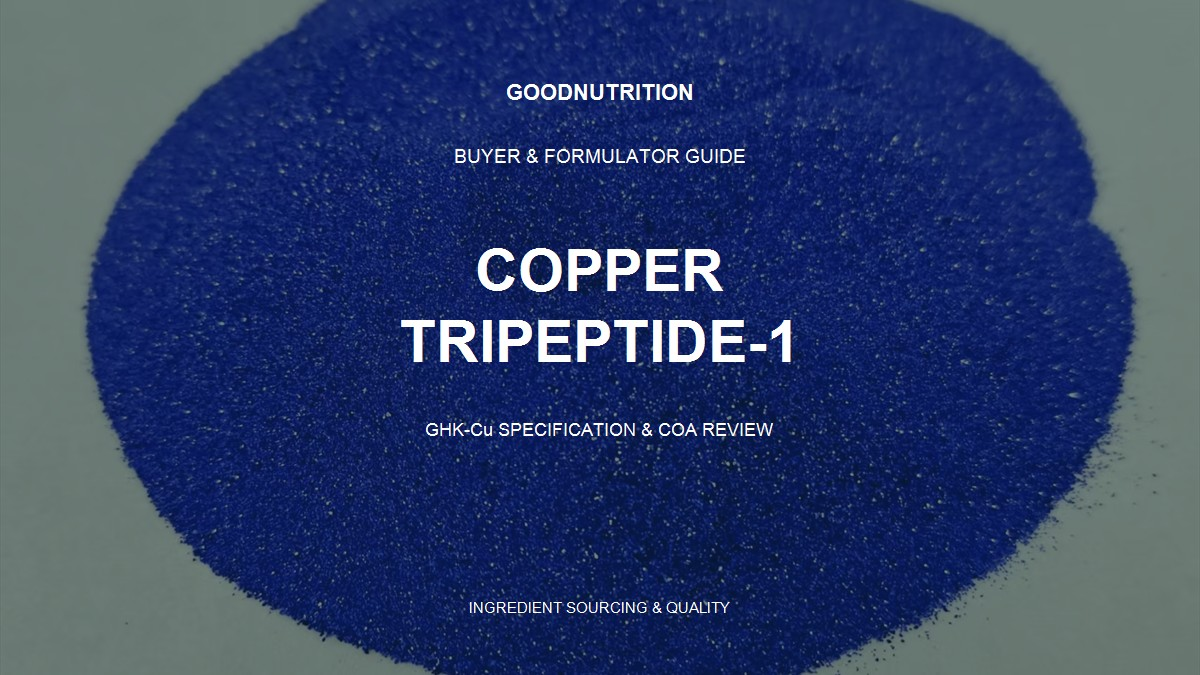
Quick answer: A Copper Tripeptide-1 specification and its lot-specific COA answer different questions. Confirm ingredient identity and grade, compare the specification’s acceptance criteria with results for the matching lot, evaluate the ingredient in the intended formula, and support finished-product claims with evidence relevant to that formula and market. Each document or laboratory result applies only to its stated sample, method and test conditions.
Start with identity and intended use
GHK-Cu is commonly used as a name for copper tripeptide, while Copper Tripeptide-1 is an INCI name used in cosmetic ingredient contexts. Confirm the identity shown on the supplier’s current specification, safety documentation and quotation, and check the applicable nomenclature and regulatory requirements for the market and product type you are developing. Do not rely on a trade name, blue color or a search result alone to establish identity.
Record the exact grade, form and intended application being quoted. If a document uses a different name, salt description, assay basis or material code, ask the supplier to explain the relationship and provide controlled supporting documentation before comparing it with an approved formula requirement.
Read the Copper Tripeptide-1 specification before comparing offers
A product specification defines the supplier’s stated acceptance criteria for a material. Review its revision date, scope, test methods, units, limits and storage conditions. Where the specification includes more than one identity or composition measure, understand how each is defined; a purity result, peptide content and copper content are not interchangeable measurements.
- Confirm the material name and identifier match the quotation and sample label.
- Record each required parameter with its unit, method, limit and specification revision.
- Ask whether any value is a typical result or a release limit.
- Clarify sample preparation and solution conditions for pH, solubility or other method-dependent tests.
- Confirm storage and handling instructions against the current controlled document.
Use the lot-specific COA for the lot it covers
A certificate of analysis reports test results for an identified sample or lot. Check that the product identifier, batch or lot number, test date, methods, units and specification basis are present and consistent. A COA from a different lot, supplier or date may help illustrate a document format, but it does not establish results for the material currently offered to your project.
Compare results with the matching specification revision and record exceptions for quality review. If the test method, sample preparation or reporting basis differs from your internal method, ask whether a technically valid comparison can be made. Do not infer identity, efficacy, safety or future-lot performance from a single assay result.
To request lot-specific records, use the supplement ingredient COA request checklist. To distinguish batch results from release criteria, read the nutraceutical ingredient COA vs. specification guide.
Keep model studies separate from product claims
Laboratory methods, cell assays, ex vivo tissue models, animal models, ingredient safety assessments and finished-product use studies have different purposes. Before relying on a study, identify the tested sample, formulation, concentration, model, comparator, endpoints, duration, sponsor and limitations. A result from one study cannot automatically be transferred to another grade, lot, formula, population or use condition.
For a finished cosmetic, ingredient-level data do not by themselves substantiate a consumer-facing performance claim. The evidence should match the finished formula, directions, claim wording, target population and intended market. Have qualified regulatory and claims reviewers assess any proposed public language under the applicable rules. For U.S. projects, consult the FDA overview of cosmetics laws and regulations; requirements in other markets need separate review. This guide makes no medical, therapeutic or finished-product efficacy claim for Copper Tripeptide-1.

Evaluate the actual formula, not just the raw material
Before scale-up, assess the ingredient in the formula and package you plan to use. Define the development question first, then choose tests that answer it. Depending on the formulation, an R&D plan may examine appearance, pH, compatibility with other ingredients, processing conditions, packaging interaction and stability over the proposed storage period. These are project-specific checks, not universal acceptance criteria.
Keep test conditions, formula version, ingredient lot, controls, time points and decision criteria in the record. If the material changes during development, document the change and decide whether the affected work needs to be repeated. A sample evaluation is a screening step; it does not guarantee the performance of a later production lot.
Use the nutraceutical ingredient sample evaluation checklist to record sample identity, evaluation scope and follow-up questions.
Questions to send with a sourcing inquiry
- What exact material name, grade and identifier are included in the offer?
- Can you provide the current specification and the COA for the sample or lot being discussed?
- Which methods and sample conditions apply to the reported assay, copper content, pH and solubility values?
- What storage, packaging and handling instructions apply to the offered material?
- Which safety and regulatory documents are available for the specific source and intended market?
- Can the supplier confirm the quoted quantity, MOQ, packaging, sample terms, lead time and destination-specific shipping conditions for this inquiry?
- What additional evidence or testing would be needed before your team approves the material for its intended formula?
Request answers against the specific offer and lot under review. Availability, sample terms, documentation and lead time can vary and should be confirmed for each project.
Common review mistakes
- Calling an old or third-party COA the current result for an offered lot.
- Comparing percentages that use different methods or reporting bases as though they measured the same thing.
- Treating a specification limit as a batch result, or a typical value as a release limit.
- Using a model study to imply the same outcome in every finished formula or in people.
- Assuming a blue appearance confirms identity, purity or formula performance.
- Publishing a study result without confirming the tested sample, source attribution, citation accuracy and permission requirements.
Frequently asked questions
Is Copper Tripeptide-1 the same as GHK-Cu?
The names are commonly associated in cosmetic ingredient contexts, but confirm the exact identity, nomenclature and grade against the controlled supplier documents and the requirements of your intended market.
Does a high purity result prove that a material will work in my formula?
No. A purity result describes a defined analytical measurement for a sample or lot. Formula compatibility, stability, finished-product performance and market claims require separate evaluation.
Can an older COA be used to qualify a new lot?
An older COA does not report results for a new lot. Use documentation that identifies the lot being evaluated and compare it with the applicable specification revision.
Do ingredient studies prove a finished cosmetic claim?
Not by themselves. Study relevance depends on the tested sample, method, formula, endpoint and intended claim. Qualified reviewers should determine whether the evidence supports the specific finished product and market.
Review a specific Copper Tripeptide-1 offer

Review the product details through the linked image, then submit your requirements through request a project-specific ingredient quote. Confirm the exact specification, available documents, lot, quantity, packaging and delivery terms for your inquiry.