Posted in: Buyer Resources
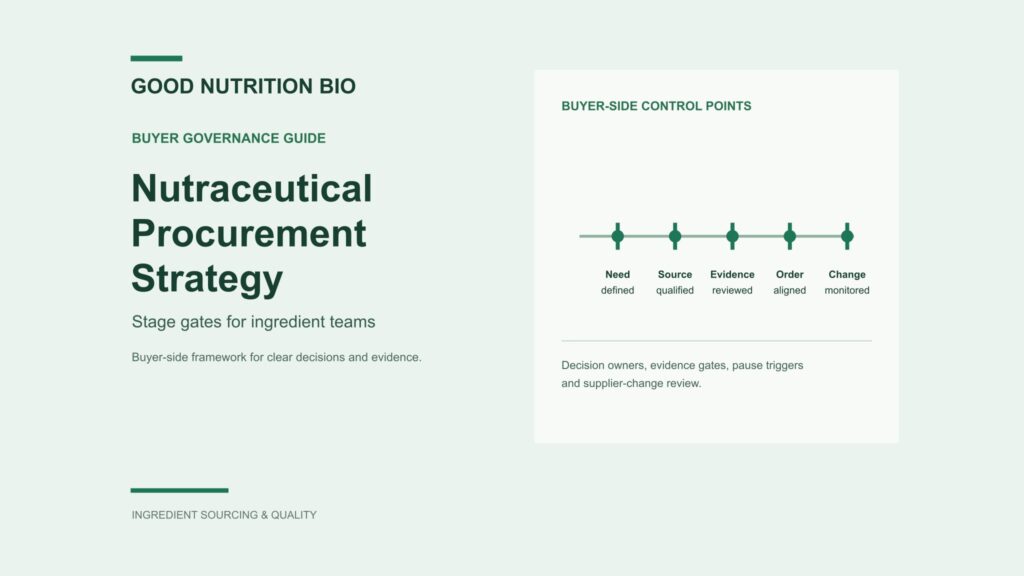
Quick answer: Nutraceutical procurement strategy defines how buyers move an ingredient project from an approved need through supplier qualification, controlled ordering, and ongoing review. Define who owns each decision, what evidence is required at each stage, and when a project must pause or return for review. This governance guide complements practical sourcing checklists; it does not replace your organization’s approved quality, regulatory, or purchasing procedures.
Ingredient sourcing can involve procurement, formulation, quality, regulatory, finance, and logistics teams. If each team reviews a different supplier, specification revision, or cost basis, a technically acceptable sample can be mistaken for commercial approval. A nutraceutical procurement strategy gives the project one documented path while leaving product-specific requirements and final authority with the buying organization.
Nutraceutical procurement strategy: separate governance from sourcing tools
A sourcing checklist helps a team complete a set of tasks. A supplier scorecard helps compare defined criteria. A nutraceutical procurement strategy sets the decision rights and evidence thresholds that determine whether the project may advance, pause, or return to an earlier stage. The framework below is intended for that governance layer; it is not a new RFQ, sample-evaluation, or inspection template.
Assign decision owners for a nutraceutical procurement strategy
Use your own organization chart and controlled procedures to name accountable people. The roles below are examples to adapt, not a prescribed GNB process.
| Function | Typical contribution | Decision boundary to define |
|---|---|---|
| Procurement | Runs supplier outreach, keeps the comparison on a consistent commercial basis, and records open terms. | Who may shortlist a source, negotiate terms, and issue or amend a purchase order? |
| Formulation or R&D | Defines the intended application, dosage form, process constraints, and technical fit questions. | Who approves the material requirements and any technical exception? |
| Quality and regulatory | Reviews the applicable specification, evidence, methods, destination-market requirements, and change controls. | Who makes qualification, document-acceptance, hold, and release decisions under controlled procedures? |
| Finance and logistics | Reviews the agreed cost basis, payment terms, shipment plan, destination, and delivery assumptions. | Which costs and delivery terms must be confirmed before commercial approval? |
| Project sponsor or approver | Resolves trade-offs and confirms that the project remains within the approved business need. | Who has final authority, and which decisions require escalation? |
Keep final supplier qualification and material-release authority inside the buyer’s approved system. A supplier’s response, a successful sample review, or a completed scorecard should not silently substitute for that authority.
Use stage gates to implement a nutraceutical procurement strategy
A nutraceutical procurement strategy should set the evidence and approval threshold for each gate before the project begins. The table is a planning framework, not a universal acceptance standard. Add, remove, or combine gates to match the material’s risk, destination, and internal controls.
| Gate | Accountable owner to assign | Decision input | Advance, pause, or return when |
|---|---|---|---|
| 1. Need and scope | Project sponsor with formulation | Intended use, dosage form, destination markets, timing, estimated demand range, and business-critical requirements. | Advance when the project has a defined use and an accountable owner. Return it if the application, market, or must-have requirements are unclear. |
| 2. Approved requirements | Formulation with quality and regulatory review as applicable | Current requirement or specification revision; mandatory attributes separated from preferences; test basis and evidence questions identified. | Advance when the team is comparing the same material and revision. Pause if requirements conflict or a requested claim has no agreed verification basis. |
| 3. Supplier shortlist | Procurement with designated qualification reviewers | Supplier and manufacturing-site identity, stated product scope, relevant available evidence, and documented gaps against buyer-defined criteria. | Advance only through the buyer’s chosen qualification path. Return for clarification when evidence does not identify the site, product, or applicable scope. |
| 4. Technical and quality fit | Quality plus formulation or R&D | Applicable specification, method and assay basis, lot-specific records where available, sample protocol, and unresolved risk questions. | Advance when authorized reviewers accept the evidence for the defined use. Pause for a basis mismatch, missing required evidence, or a sample that cannot be linked to its records. |
| 5. Commercial approval | Procurement with finance and logistics | Comparable quote basis, quantity, destination, packaging, delivery terms, current MOQ and lead time, document requirements, and approved exceptions. | Advance to an order only after transaction-specific terms and open assumptions are confirmed. Do not fill gaps with historical or assumed supplier terms. |
| 6. First-lot review | Receiving and quality under the buyer’s procedures | Order and specification revision, delivered identity and lot, package condition, required lot documents, and any observed discrepancy. | Use the buyer’s authorized release or hold process. Escalate a mismatch rather than treating an earlier sample decision as lot release. |
| 7. Ongoing review | Supplier owner with quality and project stakeholders | Defined supplier-performance measures, open deviations, delivery history, document responsiveness, and notifications of relevant changes. | Continue, requalify, or reopen earlier gates according to buyer-defined thresholds and change-control rules. |
For U.S. dietary supplement programs, review FDA 21 CFR Part 111; human-food projects may involve 21 CFR Part 117. Applicability depends on product category, market, and business role, so route requirements through the buyer’s regulatory and quality process. A nutraceutical procurement strategy should identify who confirms these questions before commercial approval.

Define pause triggers in a nutraceutical procurement strategy
Write down events that require a hold, escalation, or repeat review before the first quote is compared. Examples include a change to the named manufacturing site or material identity; a revised specification or analytical basis; a sample label that does not reconcile to its documents; an unconfirmed destination, packaging, MOQ, or delivery term; a shipment discrepancy; or a supplier change notice that may affect an approved requirement. The responsible quality, regulatory, and commercial owners should determine the response under their organization’s controlled procedures.
For each trigger, a nutraceutical procurement strategy should record who receives the notice, who assesses impact, what evidence is needed, and who can authorize the project to resume. A supplier change notice is an input to review, not by itself proof that a change is acceptable or unacceptable.
Choose review measures for a nutraceutical procurement strategy
In a nutraceutical procurement strategy, measures are useful when they prompt a defined action. A buyer may track on-time delivery against the agreed date, completeness of required lot documents, unresolved specification or identity discrepancies, response time for change notifications, and open corrective actions. Set the measurement window, owner, denominator, and escalation threshold internally; no single target applies to every ingredient, supplier, or project.
Review the measures on a schedule appropriate to the material and risk, and revisit them after a significant change, recurring deviation, or change in business use. Keep the rationale and decision in the controlled supplier or project record so a later order does not rely on an undocumented exception.
Connect a nutraceutical procurement strategy to buyer tools
Once the governance path is agreed, use the focused resources below to make the nutraceutical procurement strategy operational:
- Formulation brief to ingredient requirements for defining the use case and technical questions.
- Supplier scorecard for a buyer-defined comparison of documented criteria.
- Sample evaluation checklist for recording a sample review within the buyer’s approved process.
- Supplier change-notice checklist for organizing a reported change and its review questions.
- Nonconformance report template for documenting a requirement gap and authorized follow-up.
- Nutraceutical ingredient reorder point calculator for a buyer-defined replenishment trigger and inventory-position review.
- Procurement transformation roadmap for organization-wide workflow redesign, adoption, and review.
For a product-specific inquiry, share the ingredient and form, buyer-defined requirements, application, estimated quantity, destination, and requested evidence through Request a Quote. Specifications, batch documents, samples, packaging, MOQ, lead time, and commercial terms must be confirmed for the specific request.
For ongoing supplier qualification, specification review, and bulk sourcing support, see our nutraceutical ingredient sourcing services.
Frequently asked questions
How is a nutraceutical procurement strategy different from a sourcing checklist?
A nutraceutical procurement strategy defines decision owners, stage approvals, and pause or escalation rules. A checklist supports completion of a particular task. Use both only when each has a clear role in the buyer’s controlled process.
Does passing a sample review approve future commercial lots?
No. A sample decision applies to its defined review. Each commercial lot should follow the buyer’s approved specification, documentation, and receiving or release process.
Does a COA alone qualify a supplier?
No. A COA reports selected results for an identified lot. Supplier qualification may require additional identity, site, system, method, regulatory, or commercial evidence defined by the buyer.
Who approves a supplier change?
The buyer’s designated owners should assess the reported scope and evidence, determine whether earlier gates need to be reopened, and record an authorized decision under applicable procedures.
Are MOQ, lead time, packaging, or sample availability fixed?
No universal values are stated here. Confirm them for the requested product, specification, quantity, destination, and order timing.
Is this framework a GNB qualification procedure?
No. It is general buyer-side planning guidance. Good Nutrition Bio’s current product documents and transaction details should be requested and reviewed for the specific material and project; each buyer remains responsible for its own controlled decisions.
When the evidence, decision owner, and escalation path are defined, a nutraceutical procurement strategy gives procurement, quality, formulation, and finance teams one traceable way to advance or pause a project.