Posted in: Ingredient Buyer Guides
Salidroside is a phenolic glycoside found in Rhodiola plants. Salidroside powder 98% is an ingredient sold to a specified assay, while Rhodiola rosea extract contains a mixture of plant constituents. For bulk ingredient buyers, that distinction determines what to ask about identity, manufacturing route, analytical methods and batch documentation.
This guide explains how salidroside compares with rosavins and standardized Rhodiola extracts, why production and purification matter, and which quality documents to review before sourcing a 98% ingredient.
What is salidroside?
Salidroside consists of a tyrosol group linked to a glucose molecule. It occurs in several Rhodiola species, including Rhodiola rosea and Rhodiola crenulata. As an individual chemical compound, it can be identified and measured separately from the broader botanical extract.
This matters when reviewing a supplier’s product name. “Rhodiola extract,” “salidroside powder” and “salidroside 98%” do not describe identical materials. An extract specification should address botanical identity and its relevant marker compounds. A high-purity salidroside specification should establish the compound’s identity, assay method, acceptance limit and reporting basis.
Salidroside vs. Rhodiola rosea extract and rosavins
Rosavins and salidroside are different chemical markers. Salidroside is a phenolic glycoside; rosavins are a group of phenylpropanoid glycosides associated with Rhodiola rosea. Their concentrations should be assessed separately when both appear in a specification.
| Ingredient description | What it describes | Key buying question |
|---|---|---|
| Rhodiola rosea extract | A botanical mixture containing multiple constituents | Which species, plant part and marker specifications apply? |
| Rhodiola rosea, 3% rosavins and 1% salidroside | An extract standardized to two stated marker levels | How are both markers measured and reported? |
| Salidroside powder 98% | An ingredient specified at a high salidroside assay | What method and calculation basis support the 98% specification? |
A 3% rosavins and 1% salidroside extract cannot be treated as equivalent to a 98% salidroside ingredient. The surrounding compounds differ, and research on one material does not automatically support the same claims for the other. Select the ingredient against the formulation brief and the evidence relevant to that exact material.
Market context and botanical sourcing challenges
Rhodiola sits within a wider adaptogenic ingredient category. Grand View Research estimates that the global adaptogens market was worth USD 10.9 billion in 2024 and forecasts USD 16.3 billion by 2030, with a 7.2% compound annual growth rate for 2025–2030. These figures cover the broader adaptogens market, not salidroside alone, and do not establish the size or growth rate of the salidroside market.

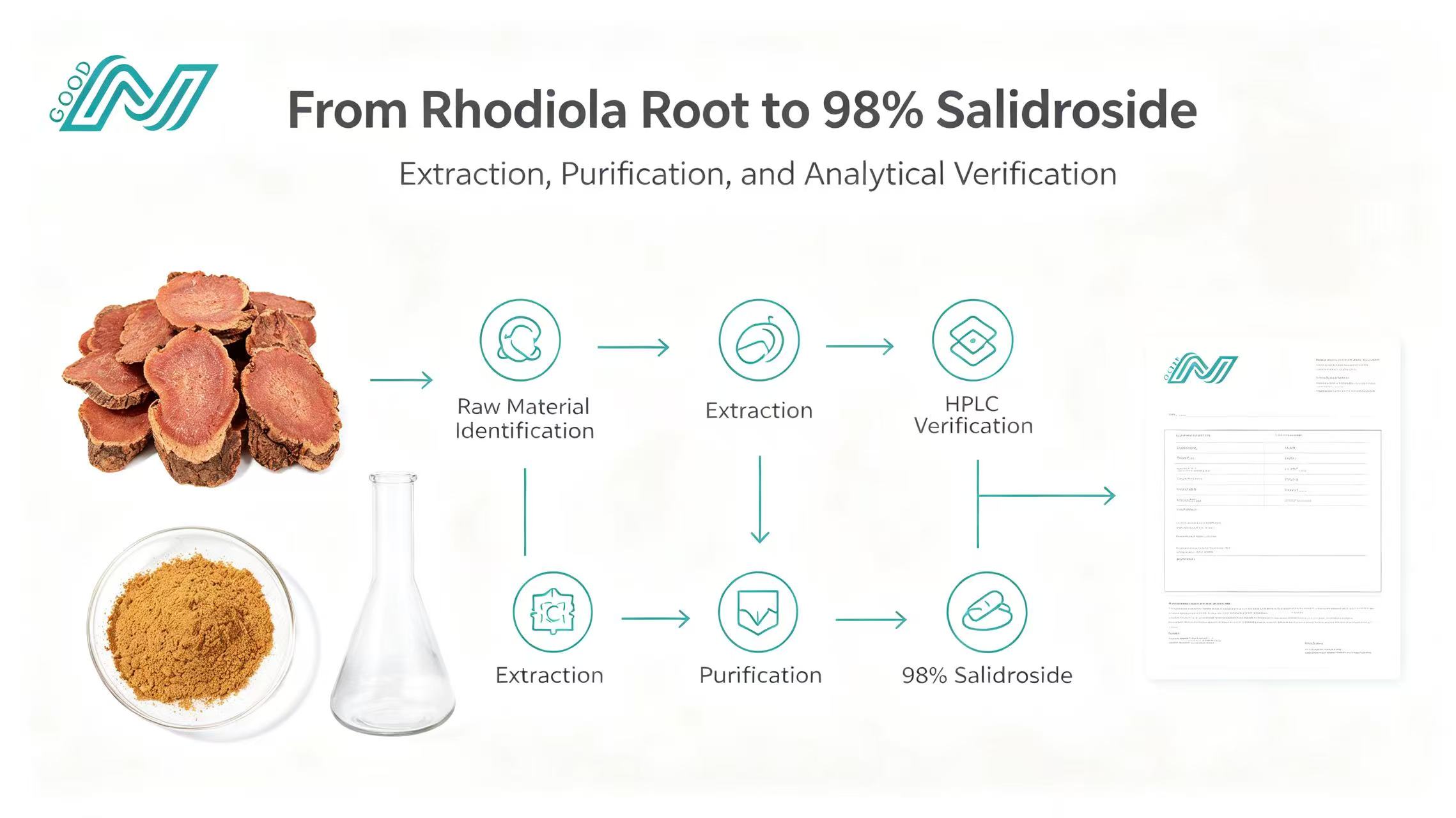
For plant-derived salidroside, species identity, growing conditions, harvest practices and raw material quality can affect supply planning and the composition entering extraction. Buyers should ask for traceability appropriate to the claimed origin. A photograph of Rhodiola roots does not establish the source of a particular batch.
Purification adds a separate challenge. The target compound must be separated from other extracted constituents, then dried and tested against the finished ingredient specification. A reliable sourcing decision therefore considers both the incoming material and the controls used to produce the final powder.
Three salidroside production routes
Plant extraction, chemical synthesis and microbial biosynthesis are distinct production approaches. The discussion below explains these approaches generally; it does not identify the manufacturing route used for Good Nutrition Bio’s product. Confirm the route and supporting documentation directly when evaluating an offer.
1. Plant extraction and purification
Botanical processing starts with identified plant material and extracts the relevant constituents before separation, concentration and purification. A high assay such as 98% requires attention to the separation of salidroside from the remaining extract components.
Ask about the botanical species, plant part, origin, extraction solvents and applicable residue testing. The final assay is only one part of the quality specification; it does not by itself establish botanical authenticity or the suitability of the full manufacturing process.
2. Chemical synthesis
Chemical synthesis offers a route that does not depend entirely on harvesting Rhodiola plants. Evaluation should address chemical identity, process-related impurities, residual solvents and purification controls. Buyers should also confirm whether the route fits their product positioning and the requirements of the destination market.
3. Microbial fermentation and biosynthesis
Researchers have engineered microorganisms to produce salidroside through biosynthetic pathways. A 2026 study in Biotechnology and Bioengineering reported 33.68 g/L salidroside using an engineered plasmid-free Escherichia coli strain in a 5 L bioreactor.
That result demonstrates a research advance. It does not establish any individual supplier’s commercial production capability, available capacity or batch purity. Commercial evaluation still requires evidence on process consistency, downstream purification and the quality of the finished ingredient.
Salidroside benefits: what the research means for buyers
Searches for salidroside benefits often combine evidence from purified salidroside with research on whole Rhodiola extracts. These materials should be evaluated separately. A study’s ingredient identity, dose, experimental model and measured outcome determine how relevant it is to a proposed formulation.
Biological mechanisms studied in cells or animals do not establish a health benefit in people. Likewise, a production study demonstrates a manufacturing result, not clinical efficacy. This sourcing guide does not establish therapeutic effects or provide a dosage recommendation.
For supplement, sports nutrition, wellness or cosmetic development, review the evidence for the exact ingredient and intended use before preparing product claims. Confirm applicable ingredient and labeling requirements in the target market; a 98% assay alone does not establish regulatory suitability.
What does a 98% salidroside specification mean?
“98%” is meaningful only when the specification explains how that result is obtained. Ask whether it refers to a minimum acceptance criterion, a measured batch result or a different reporting convention. Also check the analytical method and whether the reported value uses a dry basis, an as-is basis or another calculation.
Do not assume that a chromatographic peak-area percentage and a quantitative mass-content result mean the same thing. Moisture, reference standards and calculation methods can affect interpretation. A specification and its corresponding batch COA should make the result understandable and comparable.
A 2026 PLOS ONE analysis of 10 Rhodiola rosea supplements sold in the United States found variation in measured rosavin and salidroside content, including differences from some label claims. The products were finished supplements, not a representative survey of 98% salidroside suppliers. The findings support checking relevant analytical documentation without establishing the quality of every product on the market.
Quality documents to request from a salidroside supplier
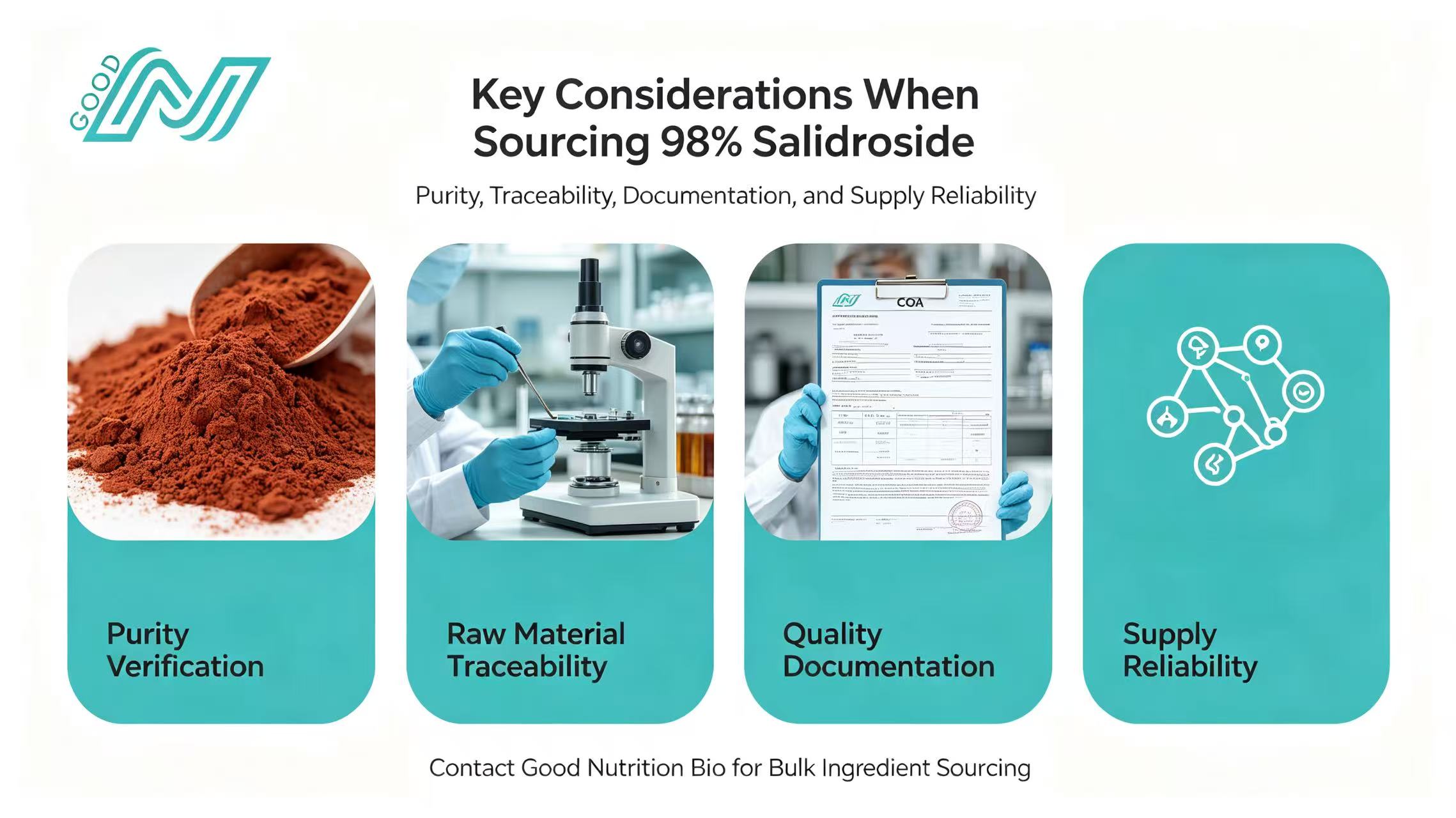
Compare bulk salidroside offers using the same requested specification. Review the documents together, and resolve gaps before qualifying the material for a commercial formulation.
| Item | What to review |
|---|---|
| Identity and origin | Compound identity, manufacturing route and traceability; botanical species and plant part where applicable |
| Assay | Acceptance limit, analytical method, reference standard and reporting basis |
| Batch COA | Lot number, test results, methods and correspondence with the current specification |
| Contaminant controls | Appropriate heavy metal, residual solvent, microbial and other testing for the process and intended market |
| Handling information | Storage conditions, packaging, stability support and available safety documentation |
| Supply terms | Requested quantity, sample availability, lead time, change notification and lot consistency expectations |
A COA is most useful when it identifies the actual lot under review and reports the relevant results. Ask for clarification where a document gives only a general product description or an unexplained “pass.” The need for independent verification should follow your qualification process and intended application.
For a broader document review process, see our nutraceutical ingredient buyer resource library and bulk ingredient supply information.
Frequently asked questions
Is salidroside the same as Rhodiola rosea extract?
No. Salidroside is an individual compound found in Rhodiola plants. Rhodiola rosea extract is a mixture that may be standardized to salidroside, rosavins or other stated markers. Match the material to the specification and evidence your formulation requires.
Does 98% salidroside prove that the powder is plant-extracted?
No. The assay describes the specified salidroside level under a stated test method; it does not establish the production route. Request origin and manufacturing information separately.
Which documents should I request before a bulk purchase?
Start with the product specification, a relevant batch COA, the assay method and reporting basis, and origin or manufacturing information. Add contaminant, handling and market-specific documentation required by your own qualification process.
Request 98% salidroside product information
Good Nutrition Bio offers 98% salidroside for B2B ingredient evaluation and product development. Share your target market, intended application, required quantity and quality requirements so the team can address your sourcing questions.
Request product specifications, a COA and a quotation for salidroside powder, or contact Good Nutrition Bio to discuss your project.
References
- Grand View Research. Adaptogens Market Size, Share & Trends Analysis Report, 2025–2030.
- Zhao, M. et al. (2026). Engineering Plasmid-Free Escherichia coli via Synergistic Metabolic Tuning and Fermentation Optimization for High-Titer Salidroside Biosynthesis. Biotechnology and Bioengineering, 123(4), 1011–1021.
- Porwollik, S. & Jafari, M. (2026). The quality and safety of Rhodiola rosea supplements on the U.S. market: An analysis of biomarkers, heavy metals, and pesticide residues. PLOS ONE, 21(1), e0341070.