Posted in: Ingredient Buyer Guides
Two quotes can both say “marigold extract” and still describe different ingredients. One may report total carotenoids; another may report lutein, lutein esters or a formulated preparation. If the assay basis and delivery format are unclear, the lower price per kilogram may not be the better fit for your formula.
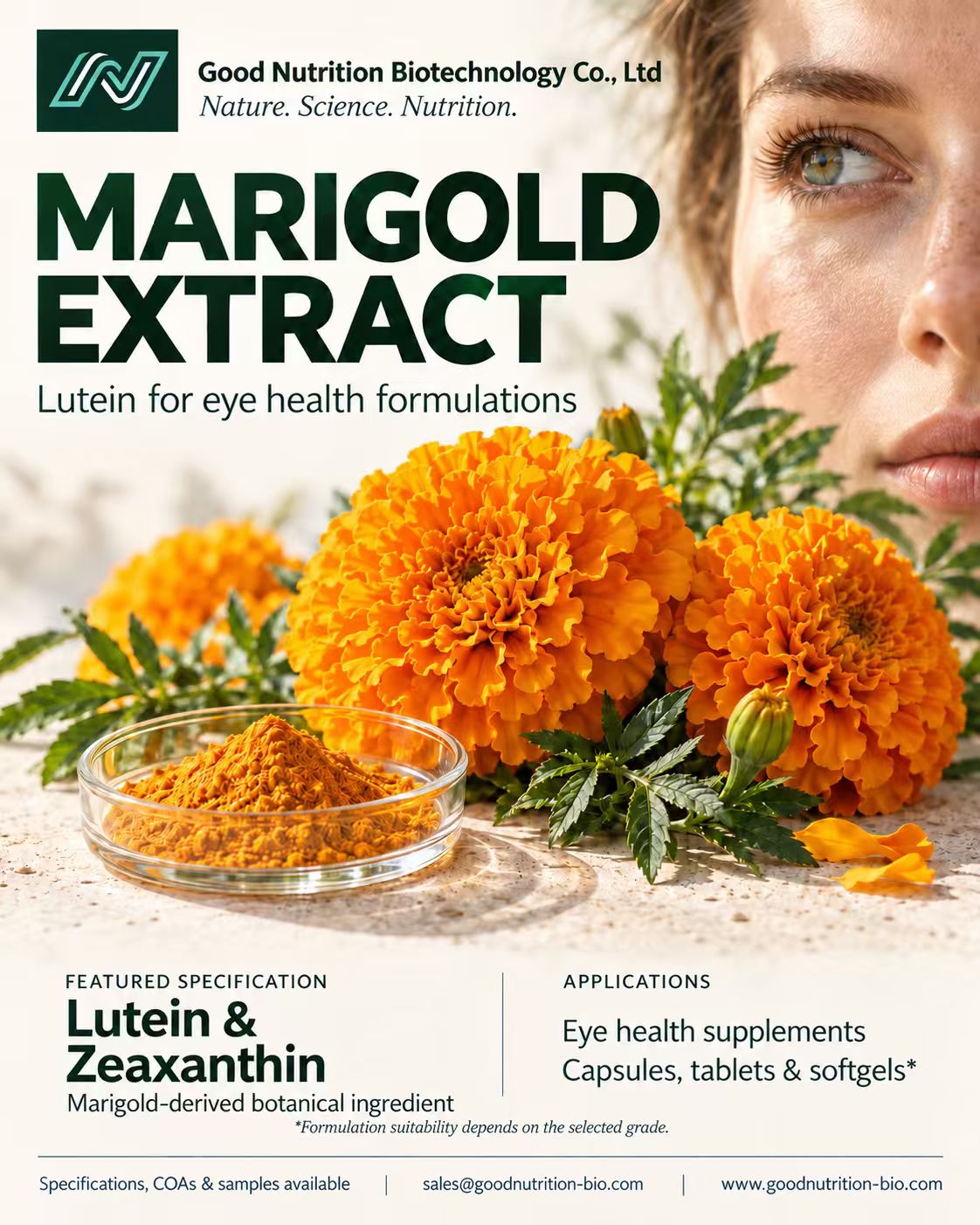
This buyer guide gives supplement formulation, quality and procurement teams a practical way to compare marigold-derived carotenoid offers. It does not replace the current grade specification, batch COA or testing in the intended finished product.
First question: what is actually being measured?
Good Nutrition Bio’s Marigold Extract product page identifies Tagetes erecta flower extract and discusses lutein and zeaxanthin. That identifies the botanical starting point, but it does not make every commercial grade equivalent. Ask what the quoted percentage represents, which method produced it and whether the value applies to the extract or the final preparation.
| Term on a quotation | What to clarify before comparing offers |
|---|---|
| Total carotenoids | Which compounds are included, and how is the total calculated? |
| Lutein | Is the result for free lutein, or expressed on another basis? |
| Lutein esters | Are esters measured directly or converted to lutein equivalents? |
| Lutein and zeaxanthin | Are both reported separately, with a stated analytical method? |
Practical rule: compare like with like. A headline percentage without the analyte, method and reporting basis is not enough for a purchasing decision.
Then match the grade to the dosage form
An assay tells you how a material was measured; it does not tell you how it will run through your process. Marigold-derived carotenoids can be supplied in different preparations, including oil, beadlet and powder formats. Availability and composition must be confirmed for the grade being quoted.
- Softgel development: ask about the oil system, carotenoid concentration, compatibility and oxidation controls.
- Capsules or tablets: review carriers, powder handling, flow and the effect of filling or compression.
- Beverage or dispersible formats: test dispersion, appearance and stability in the actual formulation.
Request a sample of the proposed commercial grade. Use that same grade in formulation and packaging trials, and confirm whether the later bulk shipment will use the same specification.
Build a document trail before the bulk order
Ask for the current specification and a batch Certificate of Analysis (COA) tied to the offered grade. Check the botanical identity, assay terms, test methods and lot identification. Depending on your market and formulation, your quality team may also need information on carriers, allergens, residual solvents, pesticides, heavy metals and microbiological limits. Agree on the required document set before purchase.
A COA reports results for a particular batch and its listed parameters. It does not by itself establish finished-product stability, labeling suitability or compliance in every destination market. Those assessments remain part of the buyer’s own development and quality process.
A ready-to-send RFQ for marigold extract
Including the application and document requirements at the start makes it easier to receive a useful grade-specific response. You can adapt this checklist for your inquiry:
- Application: intended dosage form and target market.
- Ingredient identity: Tagetes erecta material and the proposed commercial grade.
- Assay: requested lutein, zeaxanthin or total-carotenoid reporting, including method and basis.
- Format: oil, beadlet, powder or another available preparation; list any carrier restrictions.
- Quality: current specification, batch COA and any market-specific documents needed for review.
- Commercial details: estimated quantity, packaging requirements, sample request, destination, MOQ and lead time to be confirmed for that grade.
For a grade-specific response, review the Marigold Extract product details and send your RFQ to Good Nutrition Bio. Ask the team to confirm the current specification, COA availability, sample options, packaging, MOQ and lead time for the selected grade.